Deutsch
 English
Frequently Asked Questions about Vortice CA MD (FAQ)
Yes. According to the manufacturer datasheet, the Vortice CA 125 MD can be installed horizontally, vertically, or inclined. The included mounting brackets must be used to ensure a secure, stress-free mounting without transferring unauthorized forces from ductwork to the housing; for vertical installation, extra attention should be paid to the accessibility of the electrical connection. Electrical installation must be carried out exclusively by a qualified electrician.
Yes. The CA 125 MD features a three-speed motor. The three speed levels can be selected using the optional Vortice TRIO-CA. Electronic speed controllers are also available as optional accessories.
The motor is equipped with built-in thermal overload protection. In the event of abnormal overheating, the fan automatically turns off, reducing the risk of damage. According to manufacturer specifications, the overload protection and ball bearings are rated for long-term continuous operation of at least 30,000 hours at maximum surface temperature.
The Vortice CA 125 MD is suitable for circular ventilation ducts of matching nominal diameter and is used when higher pressure buildup is required — for instance in longer duct runs, bends, filters, or silencers. Selecting the correct variant depends not only on duct diameter, but on the calculated operating point derived from required airflow volume and total pressure drop of the entire system.
The airflow volume stated in the datasheet is a maximum rating of the unit, not a guaranteed rate in every system. The actual airflow achieved depends on the total resistance of the duct system — including length, bends, filters, grilles, and silencers — and is determined by the intersection of fan and system curves. Maximum airflow and maximum pressure are never reached simultaneously. You can find the performance curves for all variants in the technical datasheet (PDF).
To switch between motor speed settings, a suitable external control unit is required, such as a Vortice step switch like the Trio-CA — this is not included in the delivery and must be ordered separately. Wiring and speed selection must be performed by a qualified electrician according to the wiring diagram; third-party controllers should only be used with explicitly confirmed electrical compatibility.
The sound pressure level depends on the selected motor speed (see technical specs for manufacturer data, measured at 3 meters distance under free-field conditions). At the installation site, duct routing, airflow noise, resonances, and room acoustics can alter the actual value. For noise-sensitive applications, vibration-decoupled mounting, flexible duct connectors, and silencers are recommended.
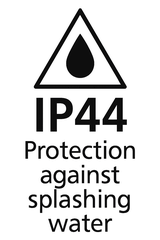
The IP rating indicates that a properly installed unit is protected against foreign solid objects and splashing water — provided it is connected to ductwork on both the intake and exhaust sides. The unit is not waterproof and is not suitable for submersion, high-pressure water jets, or unprotected outdoor installation; installation and electrical safety instructions from the manual must be followed.
Choosing the right variant is not based solely on maximum airflow, but on four values: existing or planned duct diameter, required air volume, calculated pressure drop of the entire installation, and desired control range. A smaller variant suffices for lower demands, while a larger one becomes necessary if the calculated operating point falls outside the curve — reducing duct diameter just to fit an unsuitable fan increases resistance as well as airflow noise and should be avoided. Specific examples per datasheet: CA 250 MD E or CA 315 MD E are suitable for high air requirements with high pressure buildup (long runs, many bends, filters); CA 315 MD SE offers the highest airflow of the series for high air demands with moderate pressure needs; CA 100 MD or CA 125 MD suit small or existing duct cross-sections. You can find exact figures for each variant in the technical datasheet (PDF).