
 Deutsch
 English
Dew Point Ventilation and Dew Point Controllers by Schwille
What Is Dew Point Ventilation?
Many people ventilate their basement or garage incorrectly. During summer, warm outdoor air often enters cooler rooms when windows are opened. This warm air contains a large amount of moisture, which can condense on cold walls, pipes, or windows. The result is damp walls, mold growth, and an unhealthy indoor climate.
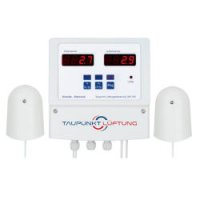
This is exactly where Schwille dew point ventilation systems come in. The controller continuously compares the moisture content of the indoor and outdoor air. Ventilation only takes place when the outdoor air is actually drier and capable of absorbing moisture from the room. This ensures that fresh air is only introduced when it contributes to dehumidification.
How Does a Schwille Dew Point Controller Work?
The systems use sensors to measure temperature and humidity both indoors and outdoors.
- Measure indoor and outdoor air conditions
- Calculate the dew point or absolute humidity
- Automatically determine whether ventilation is beneficial
- Control the connected ventilation fans
- Remove excess moisture from the room
This prevents humid outdoor air from entering the room unnecessarily. The system operates fully automatically and manages ventilation around the clock.
Advantages of Schwille Dew Point Ventilation Systems
| Benefit | Advantage |
|---|---|
| Automatic dehumidification | Reduces moisture without manual ventilation |
| Energy efficient | Uses dry outdoor air instead of power-hungry dehumidifiers |
| Mold prevention | Helps prevent mold growth and moisture damage |
| Improved indoor climate | Reduces musty odors and condensation |
| Fully automatic operation | No constant monitoring required |
| Versatile applications | Suitable for basements, garages, storage rooms, and living spaces |
Which Rooms Are Suitable for Schwille Systems?
Schwille ventilation controllers are used wherever long-term moisture control or automatic ventilation is required.
- Basements and vaulted cellars
- Garages
- Laundry and drying rooms
- Storage rooms and archives
- Holiday homes
- Living spaces
- Churches and historic buildings
- Schools, offices, and meeting rooms
For specialized applications, Schwille also offers solutions for wine cellars, conservatories, radon protection, and CO₂-controlled ventilation for classrooms and offices.
Schwille System or Dehumidifier?
Both systems have their advantages. A conventional dehumidifier actively removes water from the air and is particularly suitable for living spaces or acute moisture problems. A Schwille dew point ventilation system, on the other hand, uses the natural drying effect of outdoor air and therefore often operates much more efficiently.
| Schwille Dew Point Ventilation | Conventional Dehumidifier |
|---|---|
| Uses dry outdoor air | Actively extracts moisture from indoor air |
| Very low power consumption | Higher energy consumption |
| Ideal for basements and garages | Ideal for living areas and acute moisture issues |
| Continuous humidity control | Fast dehumidification performance |
Modern Wi-Fi and Touchscreen Controls
Many current Schwille models feature touchscreen operation, data logging, and Wi-Fi connectivity. This allows temperature, humidity, and operating data to be monitored conveniently, while settings can also be adjusted remotely. This is particularly useful for holiday homes, rental properties, or buildings that are only used occasionally.
Buy Schwille Dew Point Ventilation and Dew Point Controllers
Discover high-quality Schwille dew point ventilation controllers for automatic dehumidification and controlled ventilation of basements, garages, and many other rooms. These intelligent systems improve indoor air quality, help prevent moisture and mold problems, and operate with exceptional energy efficiency.