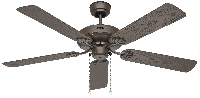
A ceiling fan not only provides pleasant cooling in summer, but also improves indoor air quality all year round.
But which model is the right one? In this guide, you will learn everything important about choosing, using, and the advantages of ceiling fans.
Why a ceiling fan makes sense
Unlike mobile fans, a ceiling fan distributes air evenly throughout the entire room. This creates a pleasant airflow
that significantly lowers the perceived temperature – without the need for an energy-intensive air conditioning system.
- even air distribution in the room
- pleasant indoor climate in summer
- supports heating in winter
Important performance data when choosing
How powerful should a ceiling fan be?
Power is specified in watts, but the decisive factor is the air flow rate. However, the following can serve as a rough guide:
Modern devices often achieve high performance with lower wattage – therefore also pay attention to the air volume (m³/h).
Noise level – when is a fan quiet?
Noise level is measured in dB(A). For living spaces and especially bedrooms, quiet operation is essential.
Tips for quiet operation
- ensure a balanced motor (all our ceiling fans are balanced)
- install the fan correctly
- do not run continuously at the highest setting
Diameter – choosing the right size
The size of the ceiling fan is crucial for effective air circulation. A unit that is too small has little effect, while one that is too large can be uncomfortable.
Additional features for the right ceiling fan
Summer and winter operation
Many modern ceiling fans feature a forward and reverse function, allowing use in both summer and winter.
Summer mode:
In summer, the fan rotates to create a direct downward airflow, producing a cooling effect on the skin.
Winter mode:
In winter, the warm air that collects near the ceiling is pushed back down. This can reduce heating costs and ensures a more even room temperature.
0–10V control
Fans with 0–10V control are mainly used in commercial settings. This allows stepless regulation and integration into building management systems.
Energy consumption – Eco ceiling fans
An energy-efficient ceiling fan uses little electricity while delivering high airflow. Modern eco models often use direct current (DC) motors.
- low wattage with high performance
- DC motors are more efficient than AC motors
- multiple speed levels prevent unnecessary energy consumption
Outdoor fans – ceiling fans for outdoor use
Special models are required for outdoor areas or humid environments.
Protection ratings (IP)
The IP rating consists of two digits. The first indicates protection against dust and contact, while the second describes protection against water. The higher the numbers, the better the protection. Examples:
- IP20: indoor use only
- IP44: protected against splashing water (bathroom, terrace)
- IP65: for demanding outdoor environments
230V or 400V – what is the difference?
Most ceiling fans for residential use operate at 230 volts. 400 V devices are mainly used in industrial environments.
- 230 volts: standard for homes and apartments
- 400 volts: high power for large halls or commercial use
Design & materials
Ceiling fans vary greatly in design and appearance, allowing you to create a specific look in a room. Different materials also offer practical advantages.
- wood blades: quiet, high-quality, cozy
- metal: durable, industrial look
- plastic: easy to maintain, often more affordable
Number of blades – important or not?
The number of blades has less impact on performance than often assumed.
- fewer blades: often faster, technically efficient
- more blades: smoother operation, visually more balanced
Accessories and extensions
Control options at a glance
Pull switch:
Classic operation directly on the unit. Pulling the cord provides simple and reliable control.
Wall switch / step controller:
A step controller is conveniently mounted on the wall. Multiple switching positions allow comfortable and precise adjustment of the fan’s speed levels. Often used in combination with light switches.
Remote control:
Convenient control of speed, lighting, and rotation direction. Especially popular in living rooms and bedrooms.
Lighting
Many models are available with integrated lighting. This saves space and is especially practical in rooms where no additional lamp is desired. When choosing, make sure lighting is included. In many cases, lighting can also be added later. Suitable lamps are also available from us.
Installation and safety
Ceiling fans must be installed securely and stably. Make sure the ceiling can support the weight and that there is sufficient distance from walls.
Tip: If unsure, installation should be carried out by a professional.
Installation height & downrods:
For optimal performance, a ceiling fan should not hang too high. A downrod allows it to be mounted lower.
- optimal: approx. 2.3 – 2.8 m above the floor
- for high ceilings: use an extension rod
- observe minimum distance from walls
Ceiling fans on sloped ceilings:
Fans can also be used on sloped ceilings. A suitable mounting system is important.
- choose models suitable for sloped ceilings
- observe maximum tilt angle
Buying a ceiling fan – our recommendation
Choose a ceiling fan that matches your room size and intended use. Particularly quiet models are recommended for bedrooms,
while more powerful variants are suitable for large rooms.
A high-quality ceiling fan is a long-term investment in comfort and energy efficiency – both in summer and winter.
FAQ / Frequently Asked Questions

 Deutsch
 English